
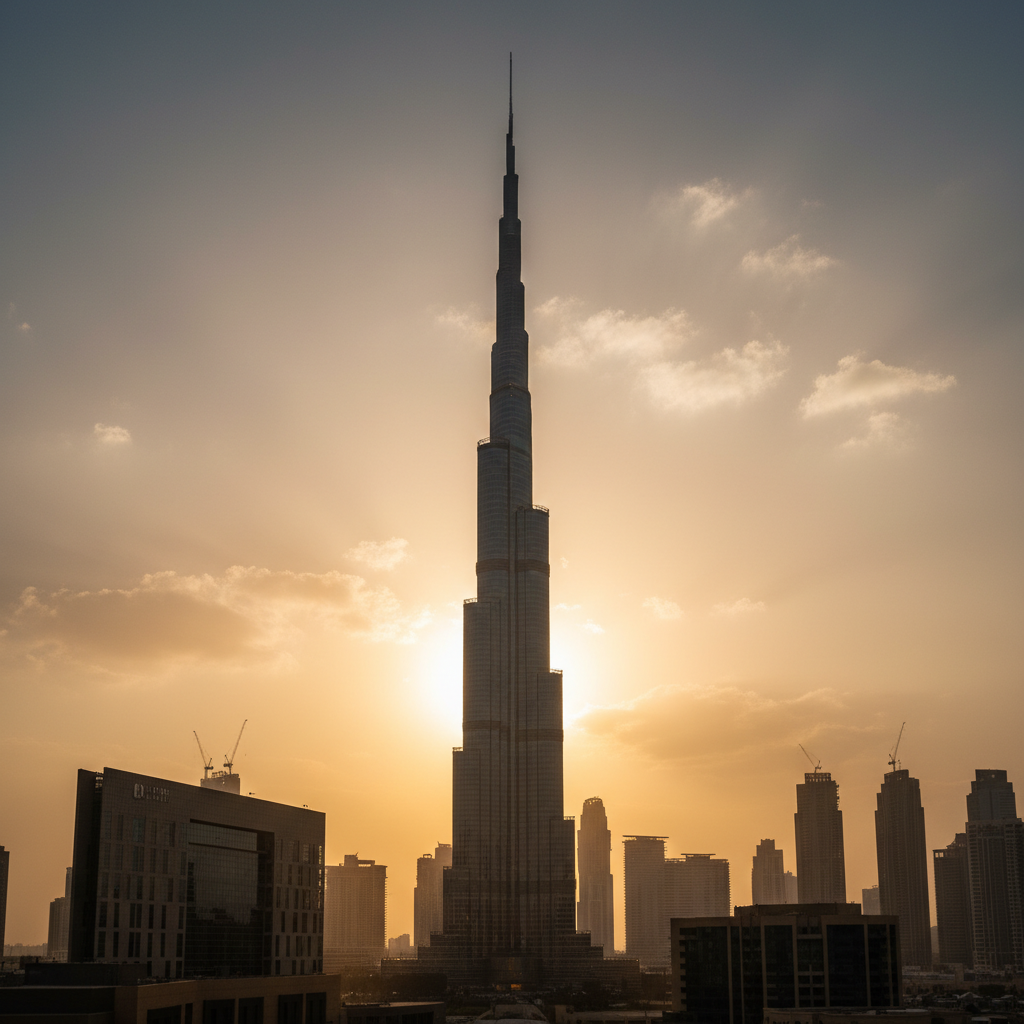
From Desert to Sky: The Engineering Marvel Behind the Burj Khalifa
Imagine a needle piercing the clouds, a shimmering testament to human ambition and ingenuity. That needle is the Burj Khalifa, a skyscraper that redefines the very concept of height. Standing at an astonishing 828 meters (2,717 feet), it’s not just a building; it’s a global icon, a beacon of modern engineering, and a symbol of Dubai’s rapid ascent. But how did this colossal structure, seemingly conjured from the desert sands, become a reality?
The journey from a visionary concept to the world’s tallest building is a story woven with groundbreaking engineering, innovative materials, and a relentless pursuit of perfection. It’s a tale of overcoming immense challenges, from the harsh desert climate to the sheer logistical complexities of building at such an unprecedented scale. Let’s delve into the engineering marvel that is the Burj Khalifa.
The Vision and the Challenge
The ambition behind the Burj Khalifa was audacious from the outset. Conceived as the centerpiece of a sprawling new urban development in Dubai, it was intended to put the city on the global map and attract tourism and investment. However, the vision presented a monumental engineering challenge. The primary goal was simple: build the tallest building in the world. This meant pushing the boundaries of what was considered possible in skyscraper construction.
Several key challenges had to be addressed:
- Height: The sheer scale of the structure required innovative design and construction techniques to ensure stability and safety.
- Wind Loads: At such extreme heights, buildings are subjected to immense wind forces. The design needed to mitigate these forces effectively.
- Foundation: Supporting a structure of this magnitude in the desert soil demanded a robust and deep foundation.
- Material Science: New materials and construction methods were needed to handle the stresses and environmental conditions.
- Logistics: Transporting materials and personnel to extreme heights posed significant logistical hurdles.
Design Philosophy: Stability and Aerodynamics
At the heart of the Burj Khalifa’s success lies its Y-shaped floor plan. This unique design, inspired by the Hymenocallis flower, was not merely aesthetic. The three-lobed footprint provides structural stability and minimizes the effect of wind. As the building rises, the wings of the Y-shape recede, creating a spiraling shape that confuses and disorients the wind, preventing it from creating powerful, resonant vortices.
This aerodynamic design is crucial. According to Adrian Smith, the chief architect at Skidmore, Owings & Merrill (SOM) who led the design, the building’s shape “was developed to confuse the wind.” This is achieved through the staggered setbacks of the building’s wings, which cause the wind to shift direction as it moves up the structure. This significantly reduces the lateral forces acting on the building, a critical factor for any supertall skyscraper.
The Buttressed Core System
The Burj Khalifa employs a buttressed core system, a sophisticated design that is central to its stability. The hexagonal central core is supported by three buttresses, which are essentially wings that extend from the core. These wings provide immense torsional resistance, preventing the building from twisting under wind and seismic loads. This system forms the structural backbone of the skyscraper.
This innovative structural system allows the building to be incredibly strong yet relatively lightweight for its size. The concrete used in the core was poured at an unprecedented height, requiring specialized pumping technology.
Engineering the Foundation: Anchoring to the Earth
Building a skyscraper of this magnitude requires a foundation that can bear an immense load and resist the forces of nature. The Burj Khalifa sits on a reinforced concrete mat, which is supported by a vast network of 192 bored reinforced concrete piles. These piles extend more than 50 meters (164 feet) deep into the ground, anchoring the skyscraper securely.
The foundation design had to account for the sandy soil of the region and the potential for seismic activity. The extensive piling system ensures that the building’s weight is distributed effectively and that it remains stable even in challenging geological conditions.
Innovative Materials and Construction Techniques
The construction of the Burj Khalifa pushed the boundaries of material science and engineering. The sheer volume of concrete required was immense, and its properties had to be optimized for the desert climate.
High-Strength Concrete
Standard concrete mixes would not suffice for the Burj Khalifa. Engineers developed a high-strength, self-compacting concrete that could withstand extreme pressures and temperatures. The concrete used in the lower levels, for instance, had to be strong enough to support the immense weight above while also being able to flow into the intricate formwork of the foundation piles.
To combat the high desert temperatures, concrete was poured at night, when temperatures were cooler. Ice was even added to the concrete mix to keep it from setting too quickly in the heat. This meticulous attention to detail was crucial for the integrity of the structure.
The Construction Process: A Vertical City
Building upwards at such a pace presented significant logistical and engineering challenges. The construction was a feat of organization and precision.
- Concrete Pumping: To pour concrete at record heights, advanced pumping systems were developed. The concrete was pumped to heights of over 600 meters (1,968 feet), a world record at the time.
- Modular Construction: While not entirely modular, certain components were prefabricated to speed up the construction process and ensure quality control.
- Cladding System: The exterior of the Burj Khalifa is clad in over 26,000 glass panels, meticulously installed by a team of skilled workers. This facade not only provides aesthetic appeal but also helps to insulate the building and protect it from the harsh desert sun.
- Cranes: At its peak, the construction site featured numerous tower cranes, essential for lifting materials and equipment to dizzying heights.
Overcoming Environmental Challenges
The desert environment presented unique obstacles that required innovative solutions:
- Heat: As mentioned, concrete pouring was done at night, and specialized mixes were used. The building’s facade also incorporates a high-performance glazing system to minimize heat gain.
- Sandstorms: The building’s design and materials had to withstand frequent sandstorms. The smooth, aerodynamic exterior helps to minimize wind resistance and the accumulation of sand.
- Water Supply: Supplying water to a building of this height is a complex undertaking. The Burj Khalifa utilizes a sophisticated water distribution system that pumps water to various levels.
The Role of Technology and Innovation
Advanced technology played a pivotal role throughout the design and construction of the Burj Khalifa. Computer-aided design (CAD) software allowed engineers to model and simulate complex structural behaviors under various conditions. Wind tunnel testing was extensively used to refine the building’s aerodynamic profile. The use of advanced materials and construction equipment, like the high-pressure concrete pumps, were essential.
The Elevator System: A Vertical Journey
With 160 floors, the Burj Khalifa requires an efficient and advanced elevator system. The building features 57 elevators and 8 escalators. The express elevators travel at speeds of up to 10 meters per second (33 feet per second), allowing occupants to reach the top floors in just over a minute. These elevators are equipped with state-of-the-art technology to ensure safety and speed.
Beyond the Height: Sustainability and Functionality
While height is its most defining characteristic, the Burj Khalifa is also a testament to sustainable design principles. The building incorporates several features to reduce its environmental impact:
- Condensate Collection System: The building’s cooling systems produce a significant amount of condensate. This water is collected and used for irrigation of the surrounding landscaping, saving millions of gallons of water annually.
- Energy Efficiency: The high-performance glazing and advanced HVAC systems help to reduce energy consumption.
- Waste Management: Comprehensive waste management systems are in place to promote recycling and minimize landfill waste.
A Legacy of Engineering Excellence
The Burj Khalifa is more than just a tall building; it’s a global benchmark for skyscraper design and construction. It demonstrates what is possible when human ambition is paired with cutting-edge engineering and a willingness to push boundaries. The project, which began in 2004 and was completed in 2010, involved thousands of workers and a global collaboration of experts.
Its construction has inspired subsequent supertall buildings and continues to be studied by engineers and architects worldwide. The Burj Khalifa stands as a powerful symbol of human achievement, a testament to our ability to transform the seemingly impossible into tangible reality, rising majestically from the desert to touch the sky.
—
Key Takeaways
- The Y-shaped floor plan of the Burj Khalifa is crucial for structural stability and wind resistance.
- A buttressed core system provides immense torsional resistance, preventing the building from twisting.
- The foundation consists of a reinforced concrete mat supported by 192 bored concrete piles extending over 50 meters deep.
- High-strength, self-compacting concrete was developed and poured at record heights, often at night to manage desert temperatures.
- The building features an advanced elevator system with express elevators capable of speeds up to 10 meters per second.
- The Burj Khalifa incorporates sustainable design features, including a condensate collection system for irrigation.
—
Frequently Asked Questions (FAQs)
Q1: How tall is the Burj Khalifa?
A1: The Burj Khalifa stands at an impressive 828 meters (2,717 feet), making it the tallest building in the world.
Q2: Who designed the Burj Khalifa?
A2: The design was led by Adrian Smith of Skidmore, Owings & Merrill (SOM), an American architectural firm.
Q3: What is the primary structural system of the Burj Khalifa?
A3: The building utilizes a buttressed core system, where a central hexagonal core is supported by three wings, providing exceptional stability.
Q4: How was the Burj Khalifa built in the desert climate?
A4: Engineers employed specialized high-strength concrete, poured primarily at night to mitigate extreme desert temperatures. Ice was even added to the mix. The facade also uses high-performance glazing to manage heat gain.
Q5: What are some of the innovative features of the Burj Khalifa?
A5: Innovations include the aerodynamic Y-shaped design, the buttressed core system, record-breaking concrete pumping, and a sophisticated water condensate collection system for irrigation.
Q6: What materials were used to construct the Burj Khalifa?
A6: The primary materials include a significant amount of concrete (over 330,000 cubic meters), steel, and over 26,000 glass panels for its exterior cladding.
—
External Links
- The Council on Tall Buildings and Urban Habitat (CTBUH): The CTBUH is a leading authority on tall buildings and sustainable urban design. Their website provides comprehensive data and analysis on skyscrapers worldwide, including the Burj Khalifa. https://www.ctbuh.org/
- Skidmore, Owings & Merrill (SOM): The architectural firm responsible for the design of the Burj Khalifa. Their portfolio showcases their extensive work on iconic structures globally. https://www.som.com/
- Guinness World Records: For verified records, including the tallest building in the world, the Guinness World Records website offers a reliable source of information. https://www.guinnessworldrecords.com/
—
Conclusion
The Burj Khalifa is a triumph of modern engineering, a structure that transcends its physical dimensions to become a symbol of human aspiration and technological prowess. From its visionary design aimed at taming the wind to its robust foundation anchored deep within the earth, every element of the Burj Khalifa is a testament to meticulous planning, innovative problem-solving, and exceptional execution. It stands not just as the world’s tallest building, but as a monument to what can be achieved when creativity meets engineering excellence, transforming a desert landscape into a skyline that reaches for the heavens.