
Burj Khalifa Lightning Technology: The Strange Engineering Story Behind the Tower That Invites Storms
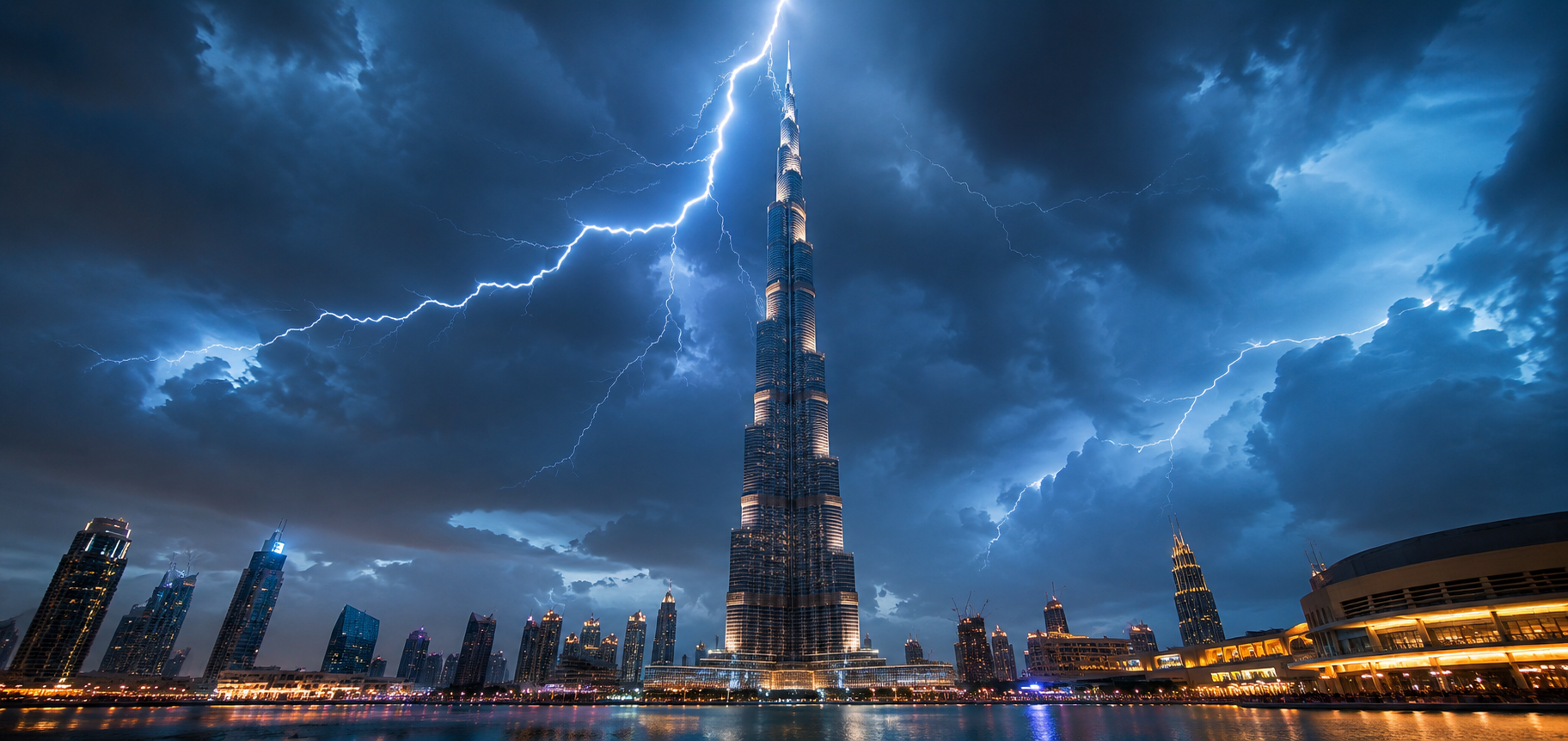
Burj Khalifa lightning technology sounds like something from a science-fiction film: the world’s tallest building standing in the middle of a desert city, repeatedly hit by lightning, yet continuing to operate as a hotel, office, residence, tourist destination and global landmark.
What makes the story so interesting is not that lightning strikes the Burj Khalifa. At 828 metres high, that is not surprising. The strange part is that the tower is designed to absorb one of nature’s most violent events and keep functioning. For business owners, IT teams, facilities managers and anyone responsible for keeping systems online, the Burj Khalifa is more than a tourist icon. It is a lesson in resilience engineering.
The Burj Khalifa is officially described as the world’s tallest structure, standing at 828 metres, with a structural system based around a spiralling Y-shaped plan and a buttressed core. Its design helps reduce wind forces while providing stability through a three-winged structure anchored to a strong central core.
That matters because tall buildings do not simply have to stand up. They have to breathe, move, cool, power, evacuate, communicate, protect, monitor and recover. In a normal office building, a storm might test the roof, power supply and network. In a supertall tower, a storm tests the entire idea of modern infrastructure.
Why Lightning Loves the Burj Khalifa
Lightning usually seeks the easiest path between cloud and ground. The taller and more exposed a structure is, the more likely it is to become part of that path. The Burj Khalifa rises far above the surrounding skyline, which makes it one of the most dramatic lightning targets on Earth.
During heavy storms in Dubai in March 2026, major news outlets reported images of lightning striking the Burj Khalifa as the UAE dealt with intense rain, thunder, strong winds and flooding. Sky News reported on 27 March 2026 that the 829-metre tower was struck during heavy weather across the region.
From a public point of view, this looks frightening. From an engineering point of view, it is expected. The question is not whether lightning will strike a tower like this. The real question is whether the building is ready when it does.
This is where the technology story becomes more useful. Good engineering does not rely on luck. It accepts risk, predicts likely events, and builds controlled pathways so that dangerous energy is managed rather than allowed to cause chaos.
That principle applies directly to business IT as well. Cyberattacks, power cuts, failed updates, hardware faults and user mistakes are not impossible events. They are predictable operational risks. The best systems are not designed around the hope that nothing will go wrong. They are designed so that when something does go wrong, the damage is contained.
Burj Khalifa Lightning Technology and the Hidden Safety Layer
Burj Khalifa lightning technology is not just about a metal point at the top of the building. It is part of a much wider safety and operational ecosystem.
ABB states that its technologies have supported the Burj Khalifa with electrification and automation since the tower was built in 2010, helping power and protect systems including HVAC, power distribution, safety systems and other operational technologies. ABB also specifically refers to earthing and lightning protection equipment and design services helping provide safe grounding and surge protection for the building, its systems and people.
That short phrase — grounding and surge protection — is extremely important. When lightning hits a building, the danger is not only the visible flash. The danger is what happens next: electrical surge, fire risk, control system disruption, equipment damage, lift disruption, communication failure, alarm faults and cascading failures through connected infrastructure.
A modern skyscraper contains a huge amount of operational technology. That includes power distribution, lift control, air handling, pumps, access control, fire safety, lighting, communications and monitoring. These systems are not just convenience features. They are part of the building’s survival system.
If a lightning strike damaged only one isolated piece of equipment, that would be a maintenance problem. If it affected multiple interdependent systems at once, it could become a safety problem. That is why lightning protection has to be viewed as part of wider resilience design.
The Tower Is Not Just Tall — It Is a Machine
It is easy to think of the Burj Khalifa as a building. In reality, it behaves more like a vertical city operated by a complex technology platform.
The official Burj Khalifa structure information explains that its mechanical, electrical and plumbing services were developed alongside the structural design. The tower’s water system supplies an average of 946,000 litres per day, its peak electrical demand is described as equivalent to around 360,000 100-watt bulbs, and seven double-height mechanical floors house vital systems such as electrical substations, water tanks, pumps and air-handling units.
Those figures show the scale of the challenge. A normal office may have a server cabinet, a router, a few switches and a small number of air-conditioning units. The Burj Khalifa has building services spread vertically through more than 160 floors.
That changes the nature of risk. A fault on one floor may affect occupants above or below. A lift problem is not just an inconvenience when people are hundreds of metres above ground. A cooling problem in a desert climate is not simply uncomfortable. It can affect safety, equipment, energy consumption and business continuity.
This is why the Burj Khalifa is a useful case study for IT and cybersecurity audiences. The same principle applies to digital systems: once a system becomes large, connected and business-critical, small failures can spread in unexpected ways.
The Strange Beauty of a Designed Lightning Strike
Most people see a lightning strike as an accident. In a properly engineered skyscraper, a lightning strike is closer to a planned event.
That does not mean engineers can control the weather. It means they can control the route that electrical energy is encouraged to take. A well-designed lightning protection system gives the current a safer path to ground, supported by earthing and surge protection. The aim is to prevent dangerous energy from travelling through the wrong systems.
The strange part is that the building almost appears to invite the strike. To the public, the tower looks exposed. To engineers, that exposure is exactly why the protection system must be robust.
This is a helpful mindset for cybersecurity. Many businesses believe that being small makes them invisible. In reality, automated attacks do not care whether a company is famous. They scan IP ranges, email domains, cloud services, weak passwords and exposed systems. The question is not whether a business is “important enough” to be attacked. The question is whether its defences can safely absorb and contain predictable threats.
A lightning strike is visible. A cyberattack often is not. But both can surge through connected systems if there is no controlled path, no monitoring, no segmentation and no recovery plan.
Wind, Shape and the Technology of Not Falling Over
The Burj Khalifa does not only deal with lightning. Wind is one of the biggest design challenges for any supertall building.
The official Burj Khalifa structural page explains that the spiralling Y-shaped plan helps reduce wind forces, while the buttressed core allows for increased height. The central core provides torsional resistance, while the wings resist wind shear.
The Institution of Civil Engineers also notes that as the tower increases in height, its wings or petals reconfigure the building’s shape, helping reduce the impact of wind and the elements.
This is important because resilience is rarely about one protective feature. The Burj Khalifa is not safe because of one lightning component, one lift system, one cooling system or one structural idea. It is safe because many layers work together.
In cybersecurity, this is called defence in depth. In building engineering, it is simply good design. Either way, the principle is the same: do not rely on a single point of protection.
A business that relies only on antivirus is exposed. A building that relies only on a lightning rod is exposed. A company that has backups but never tests restores is exposed. A tower with monitoring but poor maintenance is exposed. Resilience comes from layers.
The Lift System: A Cyber-Physical Risk Most People Forget
One of the most overlooked parts of skyscraper technology is vertical transport. In a tower like the Burj Khalifa, lifts are not just transport. They are operational lifelines.
Otis announced in March 2024 that it had been selected to modernise 34 of the Burj Khalifa’s 57 elevators and all eight escalators, alongside a 10-year service extension. Otis also stated that two double-deck elevators travel at up to 10 metres per second, reaching the 124th and 125th floor observation deck in around 60 seconds.
The same announcement explains that the elevator management system continuously monitors performance and feeds information to control-room displays. The upgraded system is described as enabling real-time remote control of equipment and hall settings, scheduled task management, and monitoring of travel, door and landing information.
This is where the technology story becomes even more relevant to modern IT. The lift system is a cyber-physical system. It uses software, sensors, control rooms, remote monitoring and operational data to move people safely through a huge vertical environment.
That creates obvious benefits: faster journeys, better monitoring, improved service scheduling and safer operation. But it also demonstrates how dependent modern infrastructure has become on digital control systems.
For small and medium-sized businesses, the lesson is not that they need skyscraper-grade lift monitoring. The lesson is that physical operations increasingly depend on connected technology. Door access systems, CCTV, heating controls, VoIP phones, cloud backups, remote monitoring, smart meters, manufacturing equipment and even printers can become part of the operational risk picture.
When technology controls the physical world, IT security becomes business safety.
Cooling the Desert: The Hidden System That Keeps the Tower Usable
A lightning storm is dramatic. Cooling is less dramatic, but just as essential.
Alfa Laval describes how the Burj Khalifa stays cool in Dubai’s heat using a district cooling setup that includes thermal ice storage. The system produces ice slurry during off-peak hours at night, stores cooling energy, and releases it later through pipelines to support indoor air conditioning and tap water systems. Alfa Laval also notes that the solution provides energy savings, uses less space than conventional cooling equipment, and gives backup support in the event of daytime chiller failure.
This is a brilliant example of resilience through timing. Instead of using maximum energy only during peak heat, the system shifts some of the cooling load to off-peak hours. In business terms, that is similar to using scheduled backups, off-site replication, automated patch windows or cloud scaling.
The best systems do not just respond to stress. They prepare before stress arrives.
For a UK business, the comparison might be less extreme than cooling the world’s tallest building in desert heat. But the principle is identical. If your busiest trading hours are Monday morning, do not schedule disruptive maintenance then. If your data is critical, do not wait until a ransomware incident to check whether the backups work. If your staff rely on Microsoft 365, do not wait for a login crisis to review MFA, recovery accounts and conditional access.
The Burj Khalifa survives because many systems are planned around stress before stress arrives.
What Makes This a Strange IT Story?
The Burj Khalifa is not normally thought of as an IT story. That is exactly why it works as one.
It is a physical landmark, but it depends on invisible technology. Its public image is glass, steel, luxury and height. Its real survival depends on grounding, earthing, automation, pumps, air handling, control rooms, lift monitoring, power distribution, cooling strategy and maintenance contracts.
That is the strange part. The building’s most impressive technology is not always visible.
The same is true inside most businesses. Customers see the website, the phones, the email address and the service. They do not see DNS records, SPF, DKIM, DMARC, endpoint protection, switch configuration, backup retention, firewall rules, patch status, user permissions or failed login attempts.
When everything works, infrastructure becomes invisible. When it fails, it becomes the only thing that matters.
The Business Continuity Lesson
The Burj Khalifa teaches a simple business lesson: resilience has to be designed in from the start, but it also has to be maintained.
The tower opened in 2010, but its operational systems have not simply been left untouched. Otis’ 2024 modernisation and 10-year service extension shows that even iconic infrastructure needs ongoing upgrades, maintenance and monitoring.
That applies directly to business technology. A firewall installed five years ago is not automatically secure today. A backup system configured once is not guaranteed to protect current data. A Microsoft 365 tenant set up quickly during growth may later contain risky forwarding rules, weak MFA exceptions, stale accounts or shared mailbox confusion.
The danger is not always that nothing was done. Often, the danger is that something was done years ago and then quietly forgotten.
Resilience is not a product. It is a cycle: design, monitor, maintain, test, update and improve.
The Cybersecurity Parallel: Controlled Paths Matter
A lightning protection system gives dangerous energy a safer path. Cybersecurity needs the same idea.
If a malicious email arrives, it should be filtered, scanned, quarantined or reported. If a password is stolen, MFA should reduce the chance of account takeover. If an endpoint is compromised, EDR should detect suspicious behaviour. If ransomware encrypts a machine, backups should provide a recovery path. If a staff member leaves, access should be removed before it becomes a risk.
In each case, the goal is not to pretend threats do not exist. The goal is to stop one event from becoming a full business failure.
This is why small businesses need layered controls:
Email filtering reduces the chance of a dangerous message reaching staff. MFA reduces the value of stolen passwords. Endpoint protection detects suspicious behaviour. Patch management closes known weaknesses. Backups provide recovery. Monitoring gives early warning. Cyber Essentials creates a baseline. Staff awareness reduces accidental clicks.
None of these controls is perfect alone. Together, they create a safer route through the storm.
Smart Buildings and the New Attack Surface
The Burj Khalifa also points to a bigger trend: buildings are becoming technology platforms.
Modern buildings increasingly include connected access control, smart lighting, HVAC automation, lift monitoring, occupancy sensors, CCTV, energy management and remote maintenance. These systems improve efficiency and safety, but they also increase dependency on secure configuration.
For large landmark buildings, this is obvious. For smaller businesses, it is easier to miss. A small office may still have cloud-managed CCTV, app-controlled heating, Wi-Fi door entry, VoIP, networked printers, smart TVs, remote desktop tools and hosted email. Each system may have its own admin portal, password policy, firmware updates and access permissions.
The more connected the workplace becomes, the more important it is to document who manages each system.
A common issue in small businesses is not that they have no technology. It is that nobody has a full map of it. One supplier installed the CCTV. Another manages broadband. Someone else set up Microsoft 365. A previous employee created the website login. The router password is unknown. The backup account uses an old email. The domain renewal goes to a mailbox nobody checks.
That is not resilience. That is hidden risk.
What UK Businesses Can Learn from the Burj Khalifa
A small UK business does not need the same engineering budget as the Burj Khalifa, but it can copy the mindset.
First, identify the systems that must keep working. That usually includes email, internet, phones, finance systems, files, backups, website, customer records and security controls.
Second, identify what could realistically go wrong. That might include power failure, broadband outage, ransomware, phishing, laptop theft, failed updates, supplier outage, domain expiry or accidental deletion.
Third, build controlled responses. Use MFA. Keep tested backups. Document admin access. Use endpoint protection. Monitor devices. Patch systems. Keep spare equipment where appropriate. Ensure domain and DNS records are managed. Review mailbox forwarding rules. Know how to contact suppliers.
Fourth, test the plan. A backup that has never been restored is only a hope. A disaster recovery plan nobody has read is only a document. A password policy with exceptions everywhere is not a policy.
The Burj Khalifa survives storms because risk is expected. Businesses improve when they adopt the same attitude.
Why the Story Works for SEO and Readers
The Burj Khalifa is visually powerful. Lightning is dramatic. Dubai storms create news interest. But the real value of this topic is that it turns curiosity into a practical technology lesson.
Readers may arrive because they want to know how the world’s tallest tower survives lightning. They should leave understanding a broader message: resilience is designed, layered and maintained.
That makes the topic suitable for a technology blog because it links engineering, smart buildings, operational technology, cybersecurity and business continuity. It is unusual enough to attract clicks, but practical enough to support Fox Technologies’ wider message around reliable IT support, monitoring, security and planning.
Practical Checklist: Build Your Own “Lightning Protection” for IT
The average business does not need a skyscraper lightning system, but it does need a digital equivalent.
Start with identity. Make sure every user has MFA, especially administrators. Remove old accounts and avoid shared logins wherever possible.
Review email security. Check spam filtering, impersonation protection, DKIM, SPF and DMARC. Look for suspicious forwarding rules and risky mailbox permissions.
Check endpoint security. Ensure laptops and desktops are patched, encrypted, monitored and protected with suitable endpoint security.
Review backups. Confirm what is backed up, how often, where it is stored, how long it is retained and whether a restore has been tested.
Document suppliers. Broadband, hosting, domains, Microsoft 365, backup, firewall, phone systems and line-of-business software should all have known support contacts and renewal details.
Plan for failure. Decide what happens if email goes down, broadband fails, a laptop is stolen, ransomware is suspected, or a key staff member leaves.
Train staff. The strongest technical setup can still be weakened by poor awareness. Short, regular training is often better than one long annual session.
Monitor continuously. The biggest risks often appear quietly: disk space warnings, failed backups, expired licences, disabled security tools, suspicious logins or old devices that have stopped checking in.
The Standout Lesson
The Burj Khalifa does not avoid lightning by hiding from it. It stands in the open, accepts that storms will come, and relies on engineering to direct danger safely away from people and critical systems.
That is the standout lesson for modern business technology.
You cannot hide from every cyber threat, power issue, supplier outage or human mistake. But you can design your systems so that one bad event does not become a disaster.
A lightning strike on the Burj Khalifa becomes a photograph. A poorly managed technology failure in a business can become downtime, lost data, reputational damage and lost revenue.
The difference is preparation.
Modern IT support is no longer just about fixing computers when they break. It is about designing resilient systems that keep a business operating when pressure arrives. The Burj Khalifa may be the world’s tallest tower, but its most useful lesson is grounded: expect risk, control the path, protect critical systems, monitor continuously and maintain the design before the storm arrives.
Internal Links
Use these naturally within WordPress:
Suggested internal link placement:
- Link “business IT support” or “resilient systems” to https://foxtechnologies.co.uk
- Link “speak to Fox Technologies about monitoring, backup and cybersecurity planning” to https://foxtechnologies.co.uk/contact
External Links
Recommended external sources to include:
- Official Burj Khalifa structure and engineering information.
- ABB information on power, automation, earthing and lightning protection at the Burj Khalifa.
- Otis announcement on Burj Khalifa elevator modernisation and monitoring systems.
- Alfa Laval case story on Burj Khalifa cooling and thermal ice-storage.
- Institution of Civil Engineers overview of the Burj Khalifa engineering project.
Disclaimer
This article is provided for educational and informational purposes only. While every effort is made to ensure accuracy, cybersecurity threats, regulations, and technologies change regularly. Readers should seek professional advice before implementing security, compliance, or business decisions based on this content. Fox Technologies accepts no liability for actions taken based on this article.